
You Already Paid for Data. Here’s How to Turn It Into 2–3% EBITDA
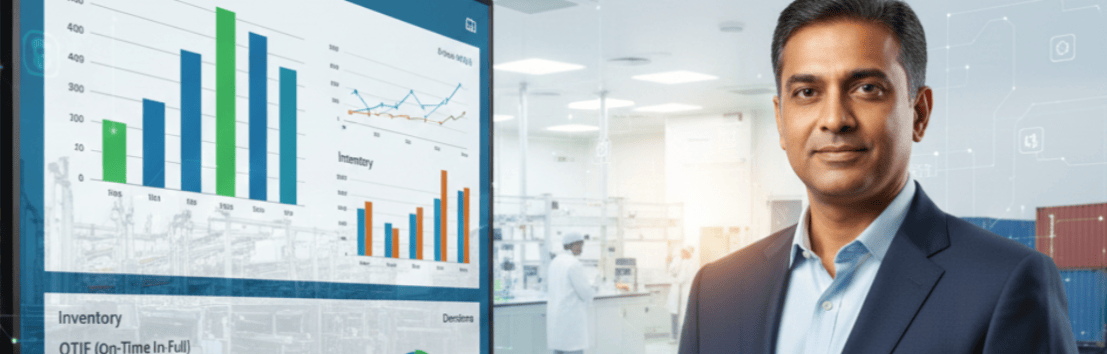
If you run an SME, MSME, or corporate in Manufacturing, Pharma, FMCG, Healthcare, Automobile, or Logistics in India, here’s a hard truth:
You’re probably paying for data every single day… ERP licenses, plant systems, TMS/WMS, LIMS, CRM, Excel power users, IT teams…
But that spend is not showing up as EBITDA.
Instead, you get:
- Endless MIS decks and Excel sheets
- Weekly review meetings that start with, “Why does my report show a different number?”
- “AI/analytics initiatives” that look great on slides and do nothing in reality
If this sounds familiar, this blog is for you.
The Real Problem: You Don’t Have a Data Shortage
Most CXOs think they have a data problem.
In reality, they have a clarity problem.
They’re “drowning in data, starving for insight”.
Across Indian mid-market and large companies, I keep seeing the same 7 patterns:
1. Data scattered everywhere
- ERP for transactions
- Excel for workarounds
- MES/SCADA in plants
- LIMS/QMS in pharma
- TMS/WMS for logistics
- Distributor portals in FMCG
- Hospital systems in healthcare
Each system is “okay” in its own silo. Nobody sees the whole picture.
2. No real-time CXO view
You want answers to simple questions:
- What’s my real OTIF today, by region and key customer?
- Which SKUs / lanes / batches are silently killing my margin?
- Which plants are really driving scrap, downtime, and rework?
Instead, you get:
- Weekly/monthly reports
- Data that’s already stale when you see it
- A “post-mortem” view, not a “control-tower” view
3. Low trust in numbers
You’ve probably heard versions of this in your reviews:
- “My team’s report shows a different figure.”
- “Finance numbers don’t match Sales.”
- “Plant says they met the target, but central MIS says they didn’t.”
When nobody trusts the data, everyone trusts their gut. Decisions become negotiation, not analysis.
4. Dependence on a few “data heroes”
Every company has them:
- The Excel wizard
- The Power BI champion
- The one IT person who “knows how to pull that report”
If they resign, go on leave, or get overloaded… Reporting slows down. Decisions slow down. Revenue slows down.
5. Expensive systems, underused
You’ve spent crores on:
- SAP / Oracle / Microsoft Dynamics / custom ERPs
- MES, SCADA, LIMS, TMS, WMS
- BI licenses
Yet, they’re used mostly for transactions and basic reporting, not decision-making and optimization.
The board keeps asking:
“Where is the ROI on all this tech?”
6. AI stuck in POC mode
You might already have:
- A “pilot project” for predictive maintenance
- A POC for demand forecasting
- A dashboard or two some teams love
But… nothing is scaled, nothing is institutionalised, and most people in your organisation have no idea those projects exist.
7. Change management is an afterthought
You built dashboards. Yet sales still calls region heads on the phone. Plant leaders still run their own Excel. Logistics teams still manage via WhatsApp.
Tools shipped ≠ transformation done.
The Silent Cost of the Status Quo
When we actually quantify the cost of this “data chaos”, it’s not small.
Typical ranges we see in Indian SMEs/MSMEs and corporates:
- 2–3% EBITDA leaking through:
- 10–20% excess inventory:
- Days of CXO time wasted each month:
If your business does ₹200 Cr, ₹500 Cr, or ₹1,000 Cr+ in revenue, even 1–2% of EBITDA is a big number.
The opportunity is hiding in plain sight – in the data you already have.
So What Does “Data-to-EBITDA” Actually Mean?
Let’s keep it very simple.
“Data-to-EBITDA” means:
Use the data you already have, in the systems you already paid for, to change 3–5 operational decisions that directly move EBITDA, working capital, or cash flow.
Not:
- Buying a new platform
- Doing a 2-year transformation
- Hiring 20 data scientists
Instead, think along these lines:
- Manufacturing / Auto components
- Pharma
- FMCG
- Healthcare
- Logistics / 3PL
Each one of these is an EBITDA lever. Data just makes it visible, measurable, and manageable in real time.
Are You Even Ready for AI? (Most Aren’t)
Most teams want to “do AI”. Very few are actually ready for it.
One tool that has worked well for CXOs is a simple readiness score.
The Data & AI Readiness Score (0–25)
Score yourself 0–5 on each:
- Data Foundation
- Use-Case Clarity
- Technology & Tools
- People & Skills
- Governance & Adoption
Rough interpretation:
- 0–10 (0–40%) – Nascent You’re paying for data, not using it. But the upside is huge – starting small can deliver outsized benefits.
- 11–17 (44–68%) – Emerging You have the plumbing, but not the pressure. A few focused use cases can quickly prove real ROI.
- 18–25 (72–100%) – Advanced You’re ready to scale AI across value chain, not just pilots.
Most Indian SMEs/MSMEs and even large corporates we see sit in the 9–15 range. Which means: enough to do serious work, but far from fully tapping the potential.
A 90-Day, No-Nonsense Path: From Data to EBITDA
Let’s be honest: You don’t need another “5-year digital roadmap deck”.
You need a 90-day path that:
- Is cheap relative to your P&L
- Uses data you already have
- Ends with something live that people actually use
Here’s a simple, practical structure:
Days 0–30: Diagnose & Score
- Connect to your core systems (ERP + key operational systems + Excel exports if needed).
- Run a Data & AI Readiness assessment across the 5 dimensions above.
- Identify 3–5 high-ROI use cases, and then narrow to 1 or 2 to start.
Deliverables you should expect:
- Clear Readiness Score (0–25)
- Shortlist of 3–5 use cases with rough value estimates
- Agreement on one plant / BU to start with
Days 31–60: One Flagship Use Case
Pick one metric that matters:
- Downtime,
- Stock-outs,
- OTIF,
- Debtor days,
- Yield,
- Lane profitability…
Then:
- Model the data properly (clean, integrate, define KPIs).
- Build one CXO/BU-head dashboard in Power BI (or your BI tool of choice).
- Add basic predictive/alerting if the data supports it.
The key here is not perfection. It’s something live, in use, by real decision-makers.
Days 61–90: Scale & Institutionalise
Once the flagship use case is live and useful:
- Roll it out to more plants/regions/customers.
- Train internal “data champions” to own and evolve it.
- Set up governance: who owns which KPI, how often it’s reviewed, what actions follow red/yellow/green status.
By Day 90, you should have:
- One or two live, trusted, high-impact dashboards/models in regular use
- A clear pipeline of next 3–5 use cases
- A stronger Data & AI Readiness Score than when you started
And, most importantly:
- A clear line of sight from data → decisions → P&L.
Where Aroha Data Fits In
At Aroha Data (www.arohadata.com), this is exactly the gap we specialise in for Indian SMEs, MSMEs, and corporates:
- We work primarily with Manufacturing, Pharma, FMCG, Healthcare, Automobile, and Logistics.
- We sit on top of your existing systems – no need for a new platform.
- We focus on data modeling, Power BI, and AI-driven analytics that directly impact operations and P&L.
We call our entry engagement the “Data-to-EBITDA Audit”:
- 30 days
- One plant / BU
- Readiness score
- 3 priority use cases
- 1 live CXO view
- Clear value estimate
From there, you can choose to scale or not. But at least you’ll know what your data is really worth.
If You’re a CXO Reading This, Here’s a Simple Next Step
If you’ve read this far, you probably suspect you’re leaving money on the table.
You have three options:
- Do nothing – and accept the current leakage as a “cost of doing business”.
- Try to fix it internally – which can work, if you empower the right people and keep scope tight.
- Run a focused 30-day audit with a partner who lives and breathes this stuff.
If you’re curious where your organisation stands:
- Score yourself quickly on the 5 Data & AI Readiness dimensions above.
- If your total is under 18, there is almost certainly low-hanging EBITDA sitting in your data.
And if you want a structured, external view:
Reach out via www.arohadata.com and ask for the “Data-to-EBITDA Audit” details. Start with just one plant or business unit. Let the numbers speak.
Because at the end of the day:
You already paid for the data. You might as well get the EBITDA.